|
This document discusses the TCW ORF finder v4.0.6.
Contents:
- ORF Finder
- Algorithm
- Executing the ORF finder
- Output files
- Summary of results
- viewSingleTCW - Viewing the ORFs
- TCW ORF finder and Trinity TransDecoder
- References
ORF Finder
The runSingleTCW annotation step computes the best ORF for each sequence using the annotation hits,
5th-order Markov model2,3 and length of candidate ORF.
|
runSingleTCW has an Option menu that allows the user to
set the ORF options, which are shown on the right.
This ORF finder algorithm was designed to find the 'best' ORF for input into runMultiTCW.
However, a file of all the 'good' ORFs can be output (see Output files).
|
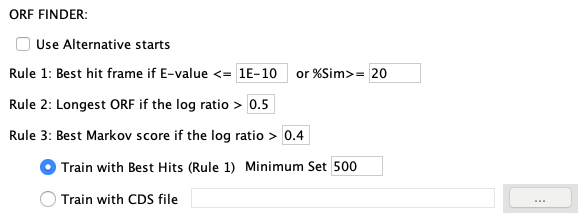
Figure 1: The runSingleTCW ORF finder options.
|
The algorithm for computing the best ORF for a given sequence is:
- For each of the 6 frames, find the best ORF as follows:
If there is a good hit with e-value < 1E-10 and similarity>20, use the hit frame.
If the hit terminates with a Start and Stop codon, use the corresponding coordinates.
Else compute all ORFs surrounding the hit and select the best based on the weight score.
If there is not a good hit, find all possible ORFs and select the best using a weighted score.
- To find the assigned ORF from the 6 ORFs found in Step 1, find the best ORF using the weighted score.
- Weighted score
- The weighted score uses: (a) Hit bitscore, similarity, and coverage, (b) length of ORF,
(c) whether it has ATG and/or Stop, and (4) Markov score.
- The weights are set so that a long ORF is selected over an ORF with a poor hit,
and an ORF with a good hit is selected over a longer ORF. The Markov
score and ATG/Stop do not have as much weight, but contribute to nudge it one way or another on close calls.
- A full-length ORF with ATG/Stop takes precedence, regardless of hit and Markov score.
Markov training set
The Markov model is trained using either of following:
- Train with Best Hits. Minimum Set [default 200]
1. The algorithm makes a list of sequences with a unique Uniprot ID and the top bitscore.
2. It sorts the list on bitscore and take the top 2000 (or maximum sequences).
3. It uses the sequence from hit-start to hit-end for the training set.
- Train with CDS file [default none]
The file name of a FASTA file of nucleotide coding sequences.
The default requires at least 200 sequences (Minimum Set). The algorithm
finds the 2000 unique longest sequences to train with; if there is not 2000, all unique sequences
will be used. The Minimum Set can be changed in the interface. The number of training sequences
can be changed by running the ORF finder from the command line, e.g.
./execAnno <project> -r -t 5000
The training set that TCW uses to create the Markov model can make a big difference in the Markov scores,
hence, resulting ORFs. If your dataset is small and there is a file of CDS sequences available, use it!
Additional heuristics
Length: An ORF must be greater than 30bp unless the sequence length is less than 30bp, then it must
be at least 9bps.
- Multi-frame: The best hit frame will be used if it has e-value < 1E-10 and similarity>20,
else the sequence is not assigned a hit for ORF finding.
- Stops in Hit: All possible ORFs are computed, and the selected one will be from those that
cover the largest region of the hit.
- Nucleotide Hit is Best Bits: If the 'Best Anno' is a protein hit, it will be used.
Executing the ORF finder
The ORF finder is run after the sequences are annotated (Step 3. Annotate in runSingleTCW).
If you want to change the ORF finder options and run it again, there is a "ORF only" function
in runSingleTCW. Or you can run it from the command line:
./execAnno <project> -r
Running from the command line will use the options set using runSingleTCW.
If Write ORFs to File is selected, the following files are written into the <project>orfFiles directory.
Table 2. Output files of the TCW ORF finder.
| bestORFs.pep.fa | The translated CDS for the best ORF for each sequence.
| | bestORFs.cds.fa | The CDS for the best ORF for each sequence.
| | bestORF.scores.txt | For the best ORF for each sequence, the 6-frame scores for the ORF.
| | allGoodORFs.pep.fa* | The translated CDSs for all good ORFs.
| | allGoodORFs.scores.txt* | A list of the coordinates and scores for all good ORFs.
| | scoreCodon.txt | The computed codon usage frequencies.
| | scoreMarkov.txt | The computed 5th-order Markov model loglikelihood.
|
* Selected hit, or >= 900nt, or good Markov score (>0 and best of 6-frames for ORF).
Example of AllGoodORFs.txt, where the first one listed is the selected ORF.
  ### Name    ntLen aaLen    Type   Frame Start..Stop     Markov  Codon
  tra_002_a    2160  720  5p-partial    3     3..2162     139.08  67.16   Hit: 3E-215  52%  84% (6..2150)
  tra_002_b     141   47  5p-partial    1  2269..2409       5.01   5.50
Example of bestORFs.scores.txt of the 6-frame scores for the best ORF:
  >tra_002   type:5p-partial seqLen:3111   orfLen:2160   ORF:3-2162(3)   Hit:2.94E-215,52%,84%
  Markov  139.08  -68.93  -26.47  -51.14  -25.33  -29.83
The first Markov score is for the ORF starting at 0 (hence, the current frame),
the next two are offset by 1 and 2 respectively, the last
three are for the reverse sequence with offsets 0,1,2.
The TCW ORF finder prints out various summary statistics to the <projects>/logs/anno.log file,
and the top part of the following is in the Overview. The results below are from a RNA-seq assembled
dataset of sequences.
ORF Stats:   Average length 1272
  Has Hit            52,854 (99.0%)    Both Ends    40,855 (76.5%)    Multi-frame    12,988 (24.3%)
  Is Longest ORF     41,639 (78.0%)    ORF>=300     48,891 (91.5%)    Stops in Hit    7,849 (14.7%)
  Markov Best Score  46,046 (86.2%)    ORF=Hit      32,253 (60.4%)    >=9 Ns in ORF       0    (0%)
  All of the above   38,628 (72.3%)      with Ends  28,922 (54.2%)

Additional ORF info                   For seqs with hit   52,859 (99.0%) ORF=Hit with Ends    28,922 (54.2%)
  One End             52,328 (98.0%)   Both Ends          40,717 (77.0%)   ORF>=300           28,012 (96.9%)
  Markov Good Frame   47,700 (89.3%)   Markov Good Frame  47,398 (89.7%)   Markov Good Frame  27,792 (96.1%)
  ORF=Hit             32,253 (60.4%)   Markov Best Score  45,724 (86.5%)   Markov Best Score  27,353 (94.6%)
  ORF~Hit              7,488 (14.0%)   Is Longest ORF     41,329 (78.2%)   Is Longest ORF     23,328 (80.7%)
  ORF>Hit             11,827 (22.1%)   Longest & Markov   38,628 (73.1%)   Longest & Markov   22,776 (78.7%)
    with Ends          4,878  (9.1%)   Not hit frame                   5   Sim>=90            28,399 (98.2%)

  Frame: 3(30.5%)  2(29.9%)  1(34.3%)  -1( 1.9%)  -2( 1.6%)  -3( 1.9%)

  Both Ends:           Has Start and Stop codon
  ORF=Hit with ends:   ORF coordinates=Hit coordinates with ends
  Markov Best Score:   Best score from best ORF for each of 6 frames
  Markov Good Frame:   Score>0 and best score from 6 RFs of selected ORF
The TCW ORF finder assigns remarks to the sequence about the selected ORF
(see TCW Basic Sequence Help, which has a "TCW Remark Legend" section).
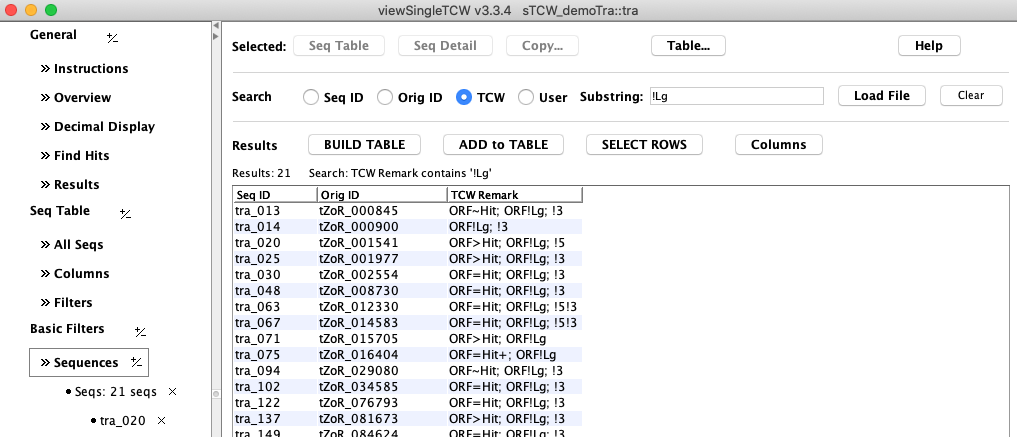
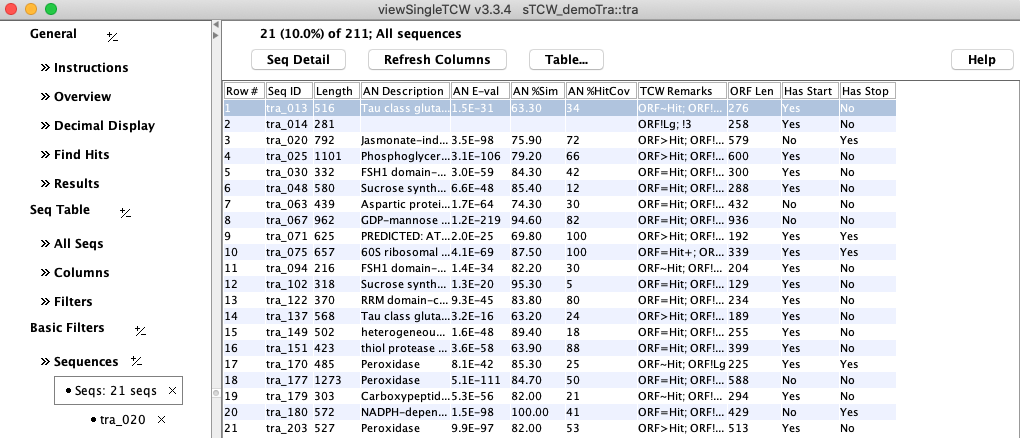
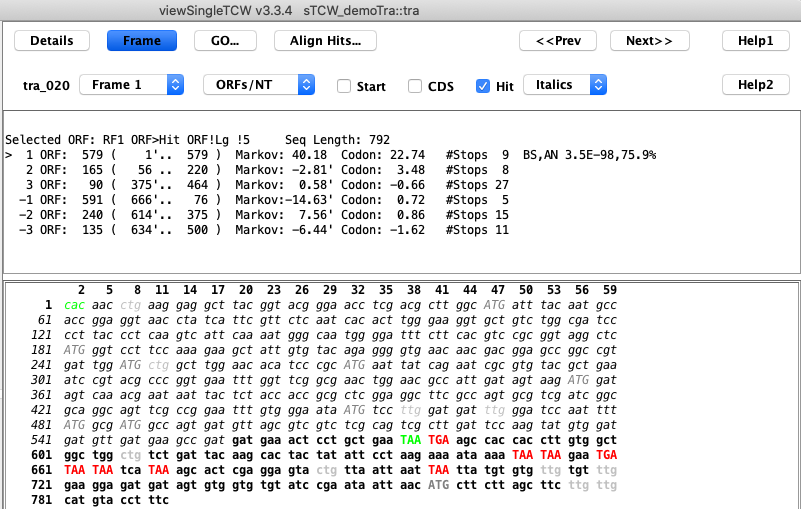
In the
images below, (A) an ORF assigned remark is searched on,
(B) the set is viewed as a Sequence table, (C) the sequence frame view and (D) the Markov scores for the best
ORF from C. Further description is provided below the set of images. Click on an image for a clearer view.
A. Basic Sequence Query for Remark
|
B. Columns of the Sequence table
|
|
C. Sequence Details Frame view
|
D. 6-frame scores for the displayed ORF

|
|
Figure 3: viewSingleTCW features for viewing the ORFs.
A. Basic Sequence Filter for TCW Remark: In
this example, the remark "!Lg" was searched on, which shows the sequences with ORFs that are not the longest.
All rows were selected and Seq Table shows them in the main Sequence table as shown in Figure 3B.
B. Columns of the Sequence table: This figure
shows most of the ORF columns. A row can be selected followed by
Seq Detail to view the frame as shown in Figure 3C.
C. Sequence Details Frame view: This example shows that the selected ORF is not the longest ORF,
but has a hit with an E-value of 3.3E-98 and good Markov and Codon scores.
D. By toggling the ORFs/NT to Scores/AA, the upper region will show the 6-frame scores of the selected ORF.
| The Markov and Codon Best Frame score is one that is positive and greater than all other frames for the ORF.
Though the Codon percentage is sometimes better than the Markov, the Markov score is much more discriminatory.
For example, when the ORF finder was executed with a file of UTRs as input, the table on the right show the
difference.
|
Table 3: Training with CDS vs UTRs
| Input | Markov | Codon
| | Hit Regions | 17783 (85%) | 19518 (93%)
| | UTRs | 5832 (28%) | 13370 (64%)
|
|
TCW ORF finder and Trinity TransDecoder
| Go to top |
Markov is the 5th-order Markov model as computed by TransDecoder3 and
originally used in GeneID2.
The TransDecoder2 Perl code for computing the reading frame specific
5th-order Markov model was translated to Java for the TCW ORF finder. However, they use different
training sets, so their scores tend to be different. They are the same +/-0.02 if either of the following
is done: (1) Use the TransDecoder longest_orfs.cds.top_500_longest as the TCW CDS file
and run ./execAnno <project> -f -r.
(2) Use the TCW orfFiles/bestORFs.cds.fa file as input to the TD score_CDS_likelihood_all_6_frames.pl
program. In either case, compare the TransDecoder longest_orfs.cds.scores (.p1 only) with the
TCW orfFiles/bestORF.scores.txt file, for the ORFs where the start and ends are the same.
For example:
TransDecoder: longest_orfs.cds.scores
 #acc    Markov_order    seq_length      score_1 score_2 score_3 score_4 score_5 score_6
 Osj_00011.p1    5       1047    83.19   0.06    15.85   27.04   26.83   5.91

TCW: bestORF.scores.txt
 >Osj_00011     type:complete   seqLen:1509   orfLen:1047   ORF:286-1332(1)   Hit:2.72E-79,45%,93%
  Markov   82.69    0.06   15.86   27.04   26.84    5.92
- GeneID: Parra G, Blanco E, Guigo R (2000) GeneID in Drosophilia. Genome Research 10:511-515.
- TransDecoder: Hass BJ, Papanicolaou A, Yassour M. et al. (2013) De novo transcript sequence
reconstruction from RNA-seq using the Trinity platform for reference generation and analysis. Nature Protocols 8:1494-1512
- Search programs used in TCW:
- BLAST: Altschul SF, Madden TL, Schaffer AA, Zhang J, Zhang Z, et al. (1997) Gapped BLAST and PSI-BLAST: a new generation of protein database search programs. Nucleic Acids Res 25: 3389-3402.
- DIAMOND: Benjamin Buchfink, Chao Xie & Daniel H. Huson, Fast and Sensitive Protein Alignment using DIAMOND, Nature Methods, 12, 59-60 (2015) doi:10.1038/nmeth.3176.
|